

Most investing advice you’ll find assumes you’re in America. Open a Roth IRA, buy an S&P 500 index fund, max your 401(k). None of that is available to you if you’re banking in cedis.
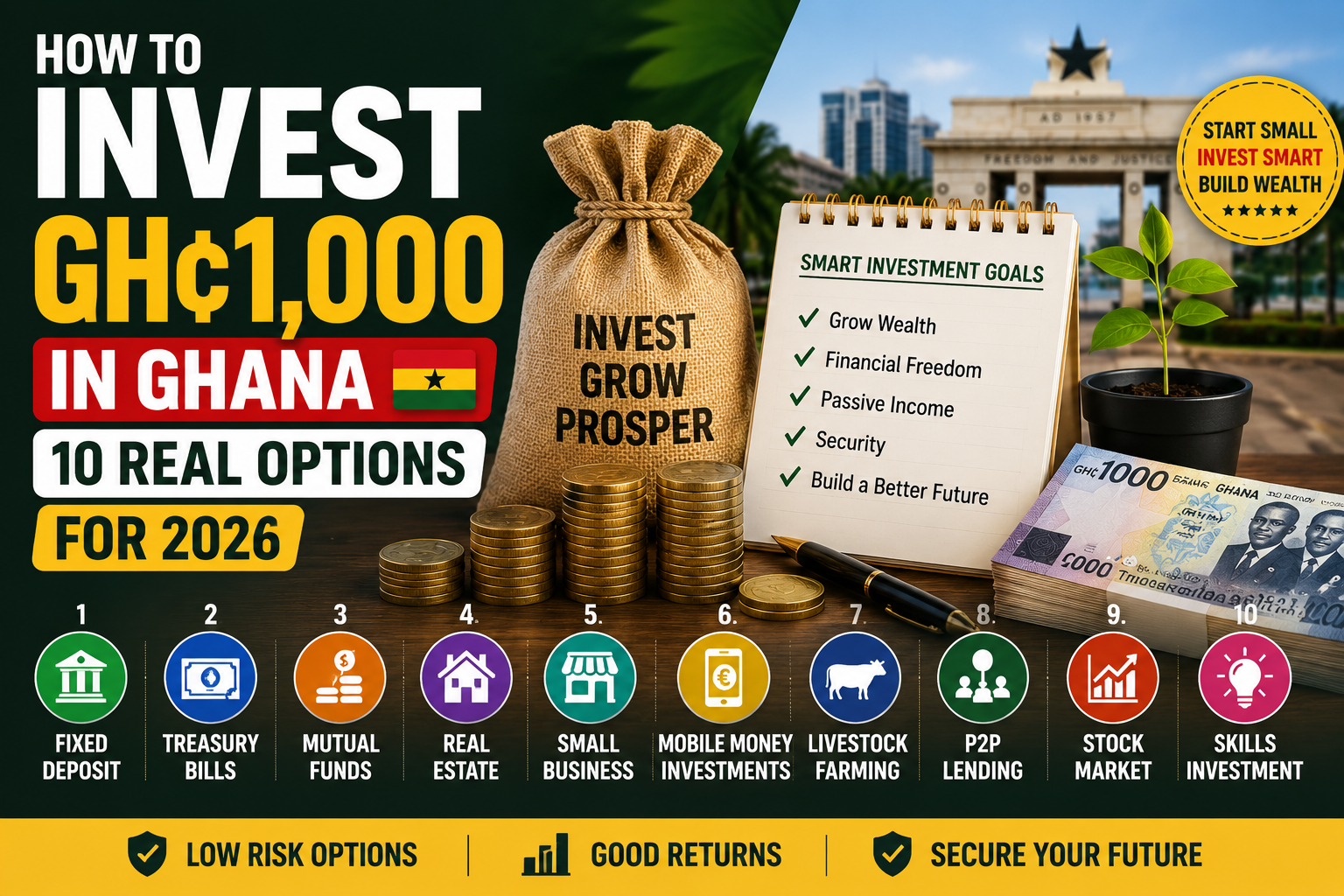
So here are ten things you can actually do with GH¢1,000 in Ghana — what each one is, what it costs you, and which ones I’d skip.
Before you invest anything
Three things come first. Skip them and investing is the wrong move, however good the returns look.
Clear expensive debt. If you’re paying 35% on a loan, paying it off is a guaranteed 35% return. Nothing on this list beats that.
Build an emergency fund. Three months of expenses in an account you can reach today. Money you might need next week should not be locked away.
Understand inflation. This is the one most people miss. If your investment returns 20% and inflation runs at 18%, you’ve gained about 2% in real terms. Check the current inflation figure from the Ghana Statistical Service before deciding whether a return is genuinely good.
Every return discussed below is nominal — before inflation. Subtract the current inflation rate to see what you actually gained in purchasing power.
1. Treasury bills
You lend money to the Government of Ghana for 91, 182 or 364 days, and get back more than you put in. It’s the lowest-risk option available here, because the borrower is the government.
Two things make T-bills the usual starting point. Interest is exempt from income tax for individual residents, which quietly improves the real return. And the minimum is low — most institutions start around GH¢100.
You’ll need a CSD account, which your bank or broker sets up as part of your first purchase. Current rates are published weekly by the Bank of Ghana.
2. Fixed deposit
You lock money with a bank for a fixed term at an agreed rate. Simpler than T-bills — no CSD account needed, you just walk into your branch.
The trade-off: fixed deposits usually pay less than treasury bills, the interest is taxable, and early withdrawal penalties are often severe. Compare the two before committing. In most conditions, T-bills win.
3. Money market funds
A fund manager pools money from many investors and puts it into short-term instruments. Databank, IC Securities and Stanbic all run them, and minimums are typically low.
More flexible than a fixed deposit — you can usually withdraw within a few days and add small amounts monthly, which suits saving little and often.
Check the management fee before you invest. A 2% annual charge takes a real bite out of a modest return, and it’s charged whether the fund performs or not.
4. Mutual funds and unit trusts
Broader than money market funds. These may hold shares and longer-dated bonds, which means higher potential returns and genuine potential for losses.
Look at the fund’s actual performance over three to five years rather than its marketing. Ask for the full fee schedule in writing. A fund that can’t produce one easily is telling you something.
5. The Ghana Stock Exchange
You buy shares in listed Ghanaian companies through a licensed broker, and you own a small piece of that business.
Be realistic about the risks. The GSE is a small market and some shares trade rarely, which means you can’t always sell when you want to. Prices move sharply on limited volume.
Reasonable for a portion of genuinely long-term money once your basics are covered. Not the place for your only GH¢1,000.
6. Tier 3 voluntary pension
Voluntary contributions on top of the mandatory Tier 1 and Tier 2 schemes. There are tax advantages, and the long lock-in enforces the discipline most of us lack.
Genuinely underrated, particularly if you’re self-employed and have no employer scheme doing this for you.
7. Mobile money savings products
MTN, Telecel and AT all offer savings or investment products through their wallets. Returns are lower than treasury bills, but the accessibility is unmatched — no branch visit, no paperwork, no minimum that shuts you out.
The best use of these is habit-building. Set up an automatic weekly transfer, however small, and move to treasury bills once you’ve accumulated a balance worth moving.
8. Foreign currency holdings
Holding dollars can protect you against cedi depreciation. It can also lose you money if the cedi strengthens.
This is a hedge, not an investment. Don’t confuse the two, and don’t move everything into dollars because the cedi fell last year — that’s reacting to what already happened rather than what will.
9. Your own skills
GH¢1,000 buys a serious professional certification. If it raises your income by GH¢300 a month, that’s GH¢3,600 in the first year and every year after.
No financial instrument in Ghana returns anything close to that. It’s unfashionable advice, and it’s frequently the correct answer when your capital is small and your career is long.
10. Crypto — read this part carefully
I’m including it because you’ll consider it anyway, so let’s be straight.
Crypto is not regulated by Ghana’s Securities and Exchange Commission. If you’re defrauded, you have essentially no recourse — no regulator to complain to, no compensation scheme. Prices routinely fall 50% or more, and most people who buy after a price surge lose money.
If you buy at all, use money you could lose entirely without it changing your life. Not your emergency fund, not your rent, and never borrowed money.
Putting GH¢1,000 to work
There’s no single right answer, but here’s a sensible starting split for someone new to this:
| Amount | Where | Why |
|---|---|---|
| GH¢600 | 91-day treasury bills | Safe, tax-free, and it teaches you the process |
| GH¢300 | Money market fund | Flexible, easy to top up monthly |
| GH¢100 | Mobile money savings | Builds the automatic saving habit |
Go through one full treasury bill cycle, see the money come back with interest, and expand from there. Confidence built on experience beats confidence built on reading.
What I’d avoid
Anything promising guaranteed high returns. Ghana has seen enough collapsed investment schemes to make this a hard rule. “Guaranteed” and “high” do not appear together honestly.
Investments you can’t explain. If you can’t describe in one sentence how it makes money, don’t put money into it.
Unlicensed operators. Check the Securities and Exchange Commission register before handing anyone money. It takes two minutes and it has saved a lot of people a lot of grief.
Following the crowd. By the time an investment is being discussed in every WhatsApp group, the easy gains have usually gone.
Where to check current figures
- Treasury bill rates — Bank of Ghana weekly auction results
- Inflation — Ghana Statistical Service
- Fund performance and fees — each provider’s published fact sheets
- Licensed operators — Securities and Exchange Commission Ghana register
Rates move constantly. Always check the live figure before you commit money, rather than relying on any number written in an article — including this one.
Last reviewed: 19 July 2026
Not financial advice. This is general educational information and doesn’t account for your personal circumstances. Investments carry risk, including loss of capital. Speak to a licensed financial adviser before making significant decisions about your money.