

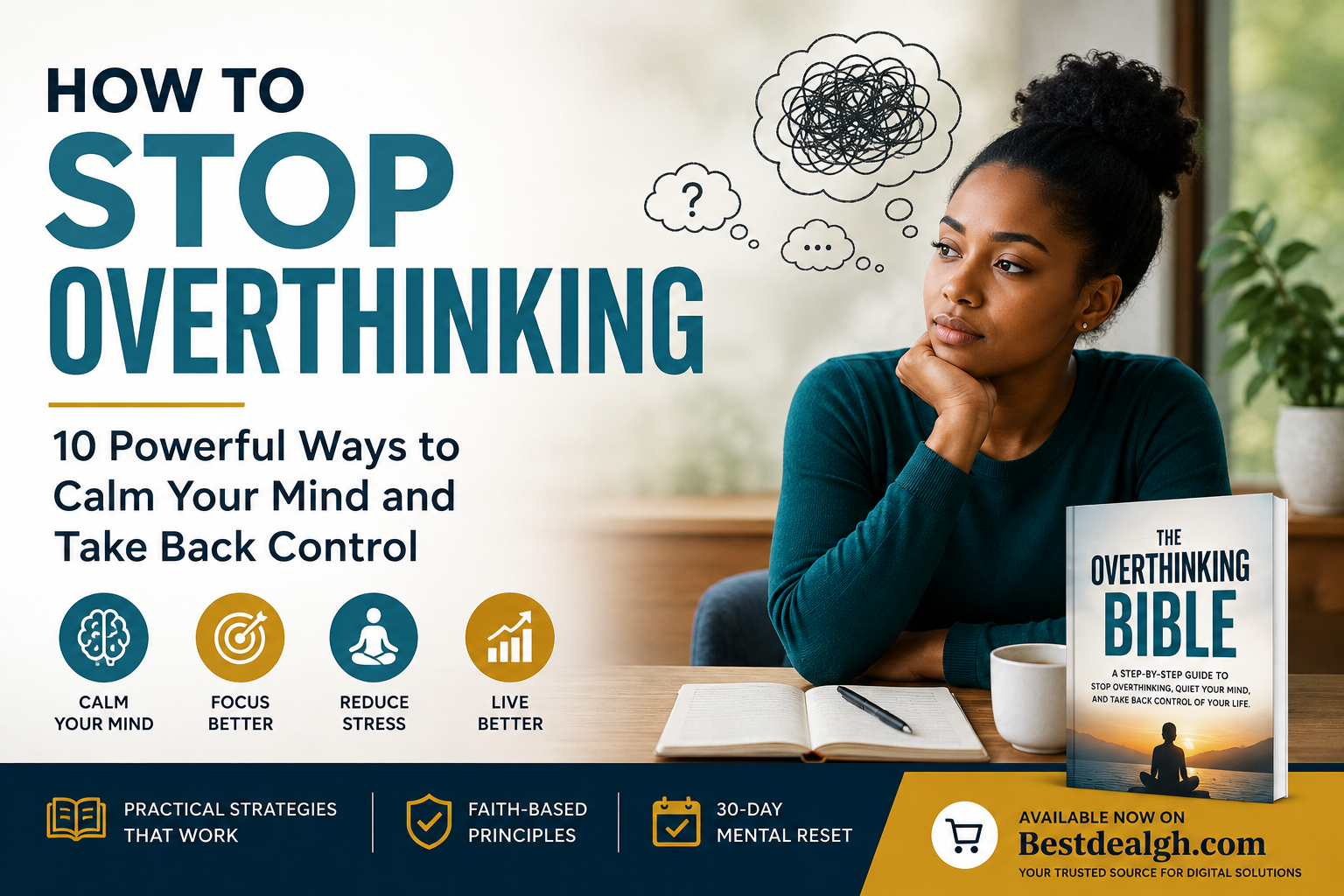
The Overthinking Bible: How to Stop Overthinking and Take Back Control of Your Mind
Have you ever replayed a conversation in your head and wondered, “Did I say the wrong thing?”
Do you spend hours thinking about decisions you have already made? Do you constantly worry about what might happen tomorrow, what someone thinks about you, or whether something will go wrong?
If so, you may be dealing with overthinking.
Overthinking can make simple decisions feel complicated, turn small problems into huge ones, and prevent you from enjoying the present moment. The good news is that overthinking is a habit of the mind—and habits can be changed.
What Is Overthinking?
Overthinking happens when your mind repeatedly analyzes, questions, or worries about something without reaching a useful conclusion.
For example:
- “What if I made the wrong decision?”
- “Why did they say that to me?”
- “What if something goes wrong?”
- “Should I have handled that situation differently?”
- “What will people think about me?”
- “What if I fail?”
Thinking about a problem can be useful when it leads to a solution. The problem begins when thinking becomes a never-ending loop.
You think about the same issue again and again, but instead of finding an answer, you become more worried.
Why Do We Overthink?
There isn’t always one reason people overthink. It can come from several factors, including fear of failure, uncertainty, perfectionism, past experiences, low confidence, or simply developing a habit of constantly analyzing situations.
Sometimes the mind believes that thinking more will give us greater control.
But thinking about a problem for three hours doesn’t necessarily produce a better answer than thinking about it for twenty minutes.
In many situations, more thinking doesn’t equal better thinking.
7 Signs That You May Be Overthinking
1. You constantly replay conversations
You remember something you said hours or even days ago and wonder whether you should have said something different.
2. You struggle to make simple decisions
Even small choices can become stressful because you keep imagining every possible outcome.
3. You worry about things that haven’t happened
Your mind creates possible future problems and then reacts to them as though they are already happening.
4. You constantly seek reassurance
You may repeatedly ask friends or family whether you made the right decision because you don’t trust your own judgment.
5. Your mind becomes especially active at night
You finally get into bed, and suddenly your brain decides it’s time to review your entire life.
6. You have difficulty letting things go
Even after a situation has ended, your mind continues returning to it.
7. You imagine the worst possible outcome
Instead of considering what could go right, your mind automatically jumps toward what could go wrong.
If several of these sound familiar, learning how to manage your thought patterns could make a significant difference in your everyday life.
How to Stop Overthinking
Stopping overthinking doesn’t mean forcing yourself to stop thinking.
Instead, the goal is to change how you respond to your thoughts.
1. Ask yourself: “Can I do anything about this?”
This is one of the simplest questions you can use.
If the answer is yes, identify one practical action you can take.
If the answer is no, continuing to analyze the situation may not help.
For example:
“What if people don’t like my decision?”
You cannot completely control what other people think.
Instead of spending hours trying to predict their reactions, focus on whether your decision was reasonable and consistent with your values.
2. Separate facts from assumptions
Overthinking often mixes facts with things we imagine might happen.
For example:
Fact: Someone hasn’t replied to your message.
Assumption: They are angry with me.
Those are not the same thing.
Before believing a negative thought, ask:
“What do I actually know?”
This simple habit can prevent your mind from turning uncertainty into fear.
3. Give yourself a decision deadline
Some decisions deserve careful consideration.
Others don’t.
If you continually postpone decisions because you’re afraid of making the wrong choice, set a reasonable deadline.
For example:
“I will consider this for 30 minutes and then make a decision.”
Once you’ve made your decision, resist reopening the case every few minutes.
4. Stop trying to achieve perfect decisions
Perfectionism can fuel overthinking.
You may believe there is one perfect decision and that choosing incorrectly will ruin everything.
But many decisions don’t have a perfect answer.
Sometimes you simply need to make the best decision you can with the information available.
5. Write your thoughts down
When your thoughts are racing, take them out of your head and put them on paper.
Write down:
- What is bothering me?
- What am I afraid will happen?
- What evidence supports this fear?
- What evidence contradicts it?
- What can I control?
- What is one action I can take?
Writing can turn a confusing collection of thoughts into a problem you can actually examine.
Overthinking in Relationships
Relationships are one of the biggest areas where people can become trapped in their thoughts.
You may wonder:
“Does he really love me?”
“Why hasn’t she replied?”
“Why did they behave differently today?”
“What did that message mean?”
The danger is that you can begin creating an entire story without having all the facts.
Healthy communication is usually better than trying to read someone’s mind.
If something genuinely concerns you, consider having a calm conversation rather than spending hours creating possible explanations.
Overthinking at Night
One of the most frustrating experiences is getting into bed and suddenly becoming overwhelmed with thoughts.
You start thinking about:
- Money
- Work
- Relationships
- Family
- Tomorrow
- Past mistakes
- Future plans
One useful approach is to create a “tomorrow list.”
Before going to bed, write down anything you need to deal with tomorrow.
For example:
Tomorrow:
- Call the client
- Pay electricity bill
- Send email
- Buy groceries
- Work on project
Once you’ve written your tasks down, remind yourself:
“I don’t need to solve everything tonight.”
If persistent worry or sleep problems are significantly affecting your life, consider speaking with a qualified healthcare professional.
The 30-Day Overthinking Challenge
You don’t need to completely change your mind in one day.
Start small.
For the next 30 days:
Week 1: Notice your recurring thoughts.
Week 2: Separate facts from assumptions.
Week 3: Practice making decisions without repeatedly reopening them.
Week 4: Practice letting go of things outside your control.
The objective isn’t to have a completely empty mind.
The objective is to develop a mind that doesn’t automatically believe every thought that appears.
Want to Go Deeper?
If you want a complete, practical guide rather than just a few tips, check out The Overthinking Bible—a step-by-step guide designed to help you understand your thinking patterns, break negative thought cycles, manage worry, build confidence, and regain control of your attention.
You can explore more digital guides and resources in the E-books section on BestDealGH.
BestDealGH provides digital products and other services for customers in Ghana, including its growing collection of ebooks.
Final Thoughts
You don’t have to believe every thought that enters your mind.
A thought is simply a thought. You can examine it, question it, and decide whether it deserves your attention.
The goal isn’t to stop thinking.
The goal is to think better.
Instead of asking yourself:
“What if everything goes wrong?”
Start asking:
“What can I do about this right now?”
That small change in thinking can be the beginning of a much calmer and more intentional life.
Ready to take control of overthinking? Explore the BestDealGH E-books collection and find the guide that fits your journey.