

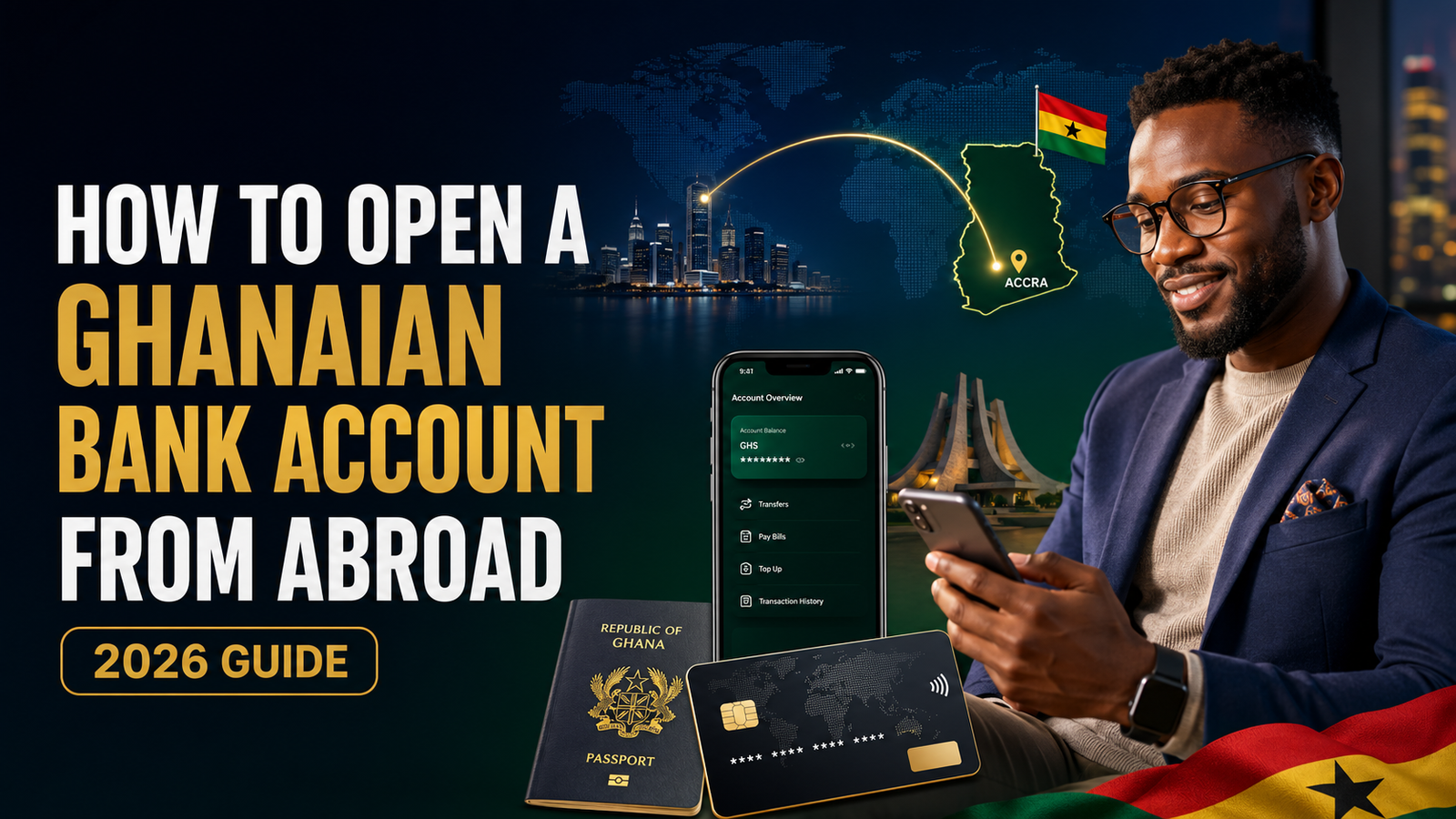
If you live abroad and want to send money home, pay for a project, receive rent, or simply hold cedis, a Ghanaian bank account makes life considerably easier. The good news is you can start the process without flying home. The important news is that what’s possible depends entirely on one thing: whether or not you’re a Ghanaian citizen.
Most guides skip past that distinction. It’s actually the whole story, so let’s start there.
The question that decides everything
Are you a Ghanaian citizen?
If yes — including if you hold dual citizenship or were born abroad to Ghanaian parents — you have access to Non-Resident Ghanaian (NRG) accounts, also called diaspora accounts. These are built for exactly your situation, and much of the process can be done remotely.
If no — if you’re a foreign national with no Ghanaian citizenship — the path is harder. Most banks will require you to hold a Ghanaian residence or work permit, and to complete the opening in person. You generally cannot open a standard Ghanaian account fully remotely as a non-citizen.
This guide covers both, but the easy, remote route is the citizen’s route. If you’re a Ghanaian who let a passport lapse, renewing it may be the single thing that unlocks the whole process — worth checking before anything else.
Account types worth knowing
Non-Resident Ghanaian (NRG) account. For Ghanaians living abroad. Offered by most major banks — Fidelity, Stanbic, GCB, Ecobank, Zenith and others. Designed for remote opening, sending money home, and managing local payments from overseas.
Foreign currency account. Holds US Dollars, British Pounds or Euros rather than cedis. Useful if you’re paid in foreign currency and want to avoid converting to cedis until you choose to. Often opened alongside an NRG account.
Standard resident account. The ordinary local account. Requires you to be in Ghana with the right documentation, and for non-citizens, usually a residence permit.
Many diaspora banking packages bundle a cedi account and a foreign currency account together, which is genuinely convenient — you receive in pounds or dollars, and convert to cedis on your own timing.
What you’ll need — Ghanaian citizens
Requirements vary slightly between banks, but an NRG application almost always asks for:
- A completed and signed account opening form
- Two passport-sized photographs
- A valid national ID — usually your Ghanaian passport or Ghana Card
- Proof of your residential address abroad — a utility bill, bank statement or tenancy agreement
- A reference, often from your current bank abroad or an existing account holder at the same bank
- An initial deposit — the amount varies by bank and account type
Many banks will ask that copies of your documents be notarised — certified by a notary, embassy or commissioner of oaths in your country of residence. This is normal. It’s how the bank verifies documents it can’t check in person.
What you’ll need — foreign nationals
If you’re not a Ghanaian citizen, expect to provide the above plus:
- A valid international passport
- A Ghanaian residence permit or work permit — banks check these as a legal requirement
- Proof of address, both abroad and often in Ghana
- In most cases, a personal visit to a branch to complete verification
The realistic summary: as a foreign national, banking in Ghana is usually something you set up after you’ve sorted residency, not before. Coordinate it with your permit application rather than expecting to do it from your laptop overseas.
The Ghana Card requirement
Ghana has been moving toward requiring the Ghana Card — the national biometric ID — for banking. If you’re a Ghanaian citizen, getting your Ghana Card sorted is increasingly central to accessing financial services here, including opening and fully operating an account.
If you don’t have one yet, look into the registration process for Ghanaians abroad through the National Identification Authority and Ghana’s missions overseas. Sort this early; it removes friction from everything downstream.
How the remote process actually works
For a Ghanaian opening an NRG account from abroad, the sequence is typically:
1. Contact the bank’s diaspora desk. Most major banks have a dedicated team for exactly this. Email them, explain your situation, and ask for their current NRG requirements — get the list from them directly, because it’s the only version guaranteed to be current.
2. Complete the application and gather documents. Fill the form, collect your ID and proof of address, and get everything notarised where required.
3. Send the documents. High-quality scans to the diaspora desk, and physical notarised copies by courier — DHL or FedEx — where the bank requires originals.
4. Fund the account. Transfer the opening balance from your bank abroad once the account is provisionally set up.
5. Complete verification. Compliance checks run, and you receive your login details. Some banks activate full functionality remotely; others hold certain features until you can visit a branch.
6. Collect your card in person. Many banks will have you complete biometric verification and collect your debit card on your next visit to Ghana. Your account can often operate before then, but plan for that final in-person step.
If you’re in the US: one thing you must not skip
American tax law reaches across borders. If you hold foreign financial accounts and their combined value exceeds $10,000 at any point in the year, you are required to file FinCEN Form 114 (the FBAR). Depending on your circumstances, further reporting on foreign assets may also apply.
This isn’t optional, and the penalties for ignoring it are severe. If you’re US-based, factor this in before opening the account, and speak to a tax professional who understands foreign account reporting. It’s a small task that prevents a large problem.
The UK and Canada have their own reporting frameworks. Wherever you are, check what your country requires of you for holding a foreign account — before you open one, not after.
Choosing a bank
Rather than name a “best” bank — the right one depends on your needs and changes over time — here’s what to compare across two or three diaspora desks:
- Whether they offer both cedi and foreign-currency accounts
- How much can genuinely be done remotely versus in-branch
- The initial deposit and any monthly maintenance fees
- Their international transfer fees and SWIFT charges
- The quality and responsiveness of the diaspora desk — email two or three and see who replies well
- Online and mobile banking that actually works from your time zone
That last point matters more than people expect. A responsive diaspora desk that answers your emails is worth more day to day than a marginally better exchange rate.
A realistic timeline
Opening an NRG account from abroad usually takes a few weeks, not a few days — notarisation, courier time, and compliance checks all add up. Start earlier than you think you need to, especially if you’re timing it around a visit home for the biometric step.
The short version
If you’re a Ghanaian citizen, an NRG diaspora account is designed for you and most of it can be done from abroad — gather notarised documents, work with the bank’s diaspora desk, and plan for one in-person visit to finish. Sort your Ghana Card early. If you’re US-based, handle your FBAR obligations.
If you’re a foreign national, plan to open your account in Ghana once your residency is in place, not remotely beforehand.
Sources
- Non-Resident Ghanaian account requirements — published forms from Fidelity Bank, Stanbic, Ecobank and other Ghanaian banks
- Ghana Card banking requirements — National Identification Authority
- US foreign account reporting — FinCEN Form 114 (FBAR) guidance
- Residence and work permits — Ghana Immigration Service
Last reviewed: 19 July 2026
Not financial or legal advice. Requirements vary by bank and change over time, and tax obligations depend on your personal circumstances. Confirm current requirements with your chosen bank, and speak to a qualified tax professional about your reporting duties before opening a foreign account.